Showing posts with label Film. Show all posts

Friday, 18 July 2008

Classic Flop?

Openly expressing dislike of what has become something of a classic of ‘British humour’ is possibly a dangerous thing – But … it is quite beyond me why the Cambridge ESOL Examinations Board should have set Kingsley Amis’s ‘Lucky Jim’ as a text for their CAE examinations, and equally beyond me why anyone should say it is funny.

I first read the thing back in the summer 1975 (I can be sure of the date because it was part of my University set reading – I was going ‘up’ to Leicester to study for a B.Sc. and some ‘wit’ had included this on the list of ‘books to study before coming’ as it was supposed to have sketches of people still teaching at the university in it – if it did, I never met them).

I didn’t find it very funny then, and I find it even less so now.

It is in the genre of ‘campus novels’ – a particularly tacky genre – and is claimed to have been ‘seminal’ – for which I shall never forgive it.

For those who don’t know, campus novels are about College and University campuses; are written by people whose whole lives have been blighted by the college experience and consequently feel it incumbent upon themselves to inflict a similar blight on the rest of their and future generations; they usually attempt to be ‘hilarious’ – and fail.

Campus Novels are loved by academics (a sort of S & M experience, I would suggest) and book critics (who tend to be failed academics - and consequently promote them as some sort of revenge taking experience). They pop up far too often on suggested reading lists and the like.

‘Lucky Jim’ supposedly changed the whole post-war generation … with little evidence to support this, I am firmly ‘in denial’.

Jim Dixon is the sort of lout who, because he had nothing better to do and is too lazy to do anything anyway, enters the University lecturing profession dishonestly – claiming interest and expertise where he has none. The book follows this thug’s adventures through a ‘red-brick’ university where he causes drunken destruction and chaos wherever he goes. He exhibits the sort of socialist rhetoric you’d expect and lands a job at the end with a millionaire.

What is clear to me (although not so clear to many at the time of publication, or since) is that Mr Amis does not like Jim – he is an ‘oink’ of the wrong class and only becomes respectable at the end as he moves into the pale blue conservative world. His luck is in escaping the not-really-university ‘red-brick’ institution, whose academic standards and personnel are only a joke.

The so called humour is in fact barely disguised contempt for the genuine changes brought on by a World War that shattered the privilege of education and class (although not so effectively). Educating this sort of person is obviously a dumbing-down in the eyes of Mr Amis.

The excellent introduction to the Penguin Edition, by David Lodge, also points out the attack being made on Graham Greene – especially on ‘The Heart of the Matter’.

There are obvious connections and references – from suicide to doing ‘the right thing’.

All I can say is I re-read, ‘The Heart of the Matter’ recently and was impressed: I re-read this slight book and found it severely wanting.

Fortunately Mr Amis went on to write better things – unfortunately, his politics went even further in the wrong direction.

Technorati Tags: , ,

Thursday, 15 May 2008

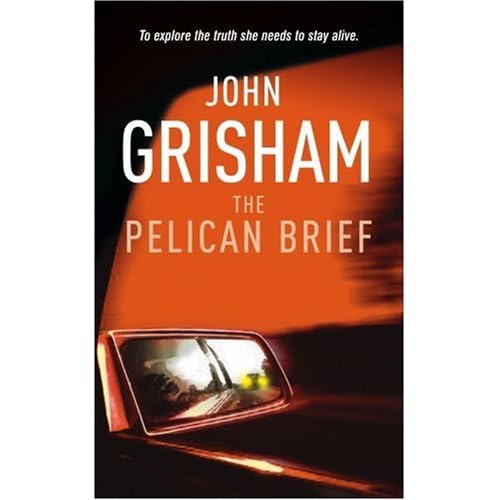
The Pelican Brief


I’ve known of the book for some time and even, on one or two occasions picked it up and considered reading it – always to return it to the shelf: For some reason I thought it was a ‘lawyer’ story.

Now, with it firmly on the CAE reading list, as a matter of duty, I’ve read it.

I am tempted to name a new literary genre:

The Time Filler.

A good time filler is strong on plot, adequate with language, sufficient with character and not too far from realism to cause concern. It will roll along never pausing for too long in any one place or with any one person, love affairs are reduced to brief encounters, killings are counted in serial-numbers and enough petrol and aviation fuel is burnt to raise the Earth’s average temperature another degree.

The Pelican Brief is a good time filler.

I took four sessions to finish the 420-odd pages, and didn’t feel pressed for time – it is a rapid read.

The plot is sort of realistic in that you can imagine someone wanting to bump off a couple of American Supreme Court justices to change the ‘political’ make-up of the Supreme court – but the book does stretch credibility a little with the descriptions and personalities of both the victims and their executioner – it seemed as though Gresham had gone through a check list of ‘most likely to make a best seller’ qualities and selected them for inclusion.

The same too with his heroine, Darby Shaw, who is a least female and intelligent – more intelligent than most of the other characters in the book. However, she never really escapes the cliché of female as victim in need of a good man to support her. Why did she have to be a blond bombshell? Why couldn’t she have been short, stumpy even, and ugly? Why does the book have to end in such a ‘happy ever after’ way on a beach?

One answer is the sales figures – and film rights.

All the way through I felt I was getting exactly what I wanted – no surprise other than a needed plot twist, no truly ambiguous character – just good guy and bad guy (and a very obvious – you got it wrong, good guy portrayed as bad).

And some very film-able locations – including Washington, New York and a pre-deluge New Orleans.

It occupied me pleasantly enough, but I ended with a – that’s it? and so what? Turned the light off, and slept well.


Technorati Tags: , ,

Thursday, 24 January 2008


With books that become films it is easy to loose track of the original intent.

I suspect that is what has happened with Atonement by Ian McEwan.

Over on the OU/BBC discussion board, there’s a classic case – the French have re-titled the film and at least one person has gone along with it.

I’ve not yet seen the cinema version and have only just read the book – it is quite stunning.

The title reflects something that isn’t fully revealed until the last section – and I don’t see how it could work on film – it is such a literary device that the impact and the ‘revelation’ would require some fairly fancy filmic devices to make it work. It reminds me a little of ‘French Lieutenant’s Woman’ – in terms of transferability.

This could account for the title change – and makes me suspicious of the film – have they missed the point?

Another element that is un-filmable for me is the description of the British debacle at Dunkirk.

My father was in the B.E.F. that went over early in the war only to be evacuated from the beaches, and, for the first time in my life, I have a sense of what it must have been like – and what it must have meant to him – from a fictional work.

No amount of documentary footage, no Hollywood style film, no fancy computer animations and sound effects could give me the shocking bitterness, the sense of failure, the almost absurd visions of the soldiers and civilians in France at that time.

A clear example of fiction being truer than fact.

Which brings me to a final aspect which I think un-filmable: The exploration in the book of the craft of writing and the nature of the novel.

To some extent all novelists (at least the good ones) are forced to consider what they are doing when they write – when they ‘fictionalize’ (if such a word exists). The choice of printed narrative as opposed to some other genre, is a conscious one.

Ian McEwan has made the foundation of his story the act of fictionalization.

"Is he trying to Atone for something?" one is tempted to ask!

Monday, 1 October 2007

Needful Things


I can’t say I enjoyed this book: I was hooked by the strong narrative line and read it rapidly; I was fascinated by the dreadful logic of the chain of events; I was disturbed by the believability of the actions of the humans: But enjoyment – No.

Stephen King manages to mix the fantastical with the mundane – evil, personified in a grotesque, with the ordinary, petty trials and tribulations of small community life.

It is a critique of that small community which lies at the heart of this book – and it is the insight Mr. King has into the workings and motivations of the human decision making process which allow him to so believably destroy the fragile bonds which maintain such communities.

The book has its fair share of action and blood, explosion and bullet – but the real horror is the gullibility of the people, the ease with which deceit can be foisted on them and the tenacity with which they hold on to that deceit.

I can’t say I enjoyed it, but I can say it was well worth reading – and that I took a lot from it. I certainly will read more of Mr. King’s works, but I think I want to visit sunnier climes first – maybe a simple murder yarn?


Wiki: Needful Things

Wednesday, 24 January 2007

Sisyphus, Androids and Mercer

There is certainly something in the connection between the legend of Sisyphus and the daily, never-ending battle against rogue Androids in 'Do Androids Dream of Electric Sheep'.

Sisyphus is condemned to push a heavy rock up a hill and will only be released once he reaches the top - but, as the top approaches, the rock escapes and runs down to the bottom of the hill: Sisyphus has to start all over again.

This is a metaphor for never ending toil - the sort of toil needed to keep a vegetable garden weeded (before the 'devil-opment' [sorry, I'm organic] of chemical weed-killers), or perhaps that of the worker on a production line doing a repetitive job at the command of a conveyor belt.

As this, there is nothing special in P.K. Dick's use of the myth for Rick Deckard's set toil - if he had it in mind at all. Camus applied the myth as a metaphor to modern life – but modern life didn’t consciously apply the myth to itself – Camus simply made the connection. Dick could simply have had modern life in mind when developing the story rather than the myth of Sisyphus.

One interesting question people don't often ask about the myth is, "Why was Sisyphus condemned to this punishment?"

Sisyphus has attempted to deceive - deception is at the root of the labour.

Is their deception in, 'Do Androids...'?

Rather a lot.

Rick opens the novel being woken by a shock from his organ [sorry, it's 'second childishness' creeping in: And whilst I’m at it, what are nom-de-plumbs for if not to replace unfortunate surnames like ‘Dick’?].

His mood is artificially set; it is not honest. His wife, who has an element of fight against this sort of mind control, refuses to participate in the deception of induced moods.

The androids themselves are a deception – multi-layered: They are not human but look it; they do the essential work human’s think they are too superior for in space (but still perform on earth – by using ‘chickenheads’, classified as subhuman); the Rosen Association develops increasing sophisticated androids which are designed to ‘cheat’ the tests of bounty hunters like Rick; and the androids don’t necessarily know they are androids as they are given false memories.

And what are we to make of electric sheep?

The pastoral myth of carefree shepherds is set in contrast to Sisyphrian labour: However, the sheep are as likely to be an electric deception as real.

The result of these deceptions is the labour which dehumanises Rick and which he longs to escape. (Interestingly enough, the Dream Factory film version lets him do so at the end – not that I have seen it.)

And a final twisting deception: Rick’s job is to protect humanity from the ‘de-human’, from the android - that labour is itself dehumanising.

There are certainly strong parallels between the Myth and the novel, but I still don’t think we can yet say Dick consciously used the myth.

So let’s turn to Mercerism: Here is the strongest evidence that P.K. Dick refers to Sisyphus knowingly.

What happens when humans grasp the handles of the empathy box?

It is in a landscape of barrenness, reminiscent of Jesus in the wilderness, that humans merge, to toil up a merciless hill, “Impossible to make out the end. Too far. But it would come.” (Chapter 2, pg. 20)

This repeated climbing of a hill is surely direct reference to the Sisyphus myth – with a difference: The top is attainable.

We first encounter the empathy box in the hands of the ‘chickenhead’, John Isidore – and he has been to the top – where the ‘other part of it’ begins.

Whatever this other part is, however painful, people still join together through the empathy box in order to struggle to attain it.

We have to be careful though with any information that comes via Isidore – he is, after all, a ‘special’. P.K. gives some intriguing information about the finding and early existence of the character – he was picked up from a boat off the coast (possibly Mexico) is adopted by a family called Mercer (!) and seemed to have the ability to bring dead animals back to life – which made him, “…. more special than any of the other specials.” (Chap 2, pg. 21)

I am not so sure that ordinary humans manage to get to the top – their existence is more bound to the labour of Sisyphus than this special’s is.

Saturday, 13 January 2007

Caryatids, Androids and Empathy


Been watching TV again!

This one was a design programme - and a couple of 'scientists pointed out we like symetry because the human face is symetrical.

An aside was, 'the most satisfying sort of column is a caryatid': Empathy.

Loud church bells, explosions and fireworks.

The difference between the android and the human is empathy.

But, the android is a personification - what is personification but empathy?

Is there a delicious paradox at the heart of, 'Do Androids Dream of Electric Sheep'?

Are we attracted to the android because we empathise with its humanness: But, it is its lack of empathy that stops it from being human.

Friday, 12 January 2007

Androids

What is an android?

If you strip away the pseudo-scientific gobbledegook, and come to the realisation that androids not only don't exist, but have nothing to do with science, what are you left with?

Personification.

Androids are a literary device - a personification (possibly the ultimate personification).

Which brings us to the question, what do they personify?

Dick seems to have taken the idea of a force, let us call it intellect - although I am not happy with that - and given it as the major component of android persona. Because it is a full personification and not a simple representation, the android needs to be given a much more rounded character - so cruelty is thrown in, and ambition; there is a lust for power and even sexual satisfaction.

But, as with all personification, it is an abstraction - anything more would take the android into full humanity.

The point of personification might be to bring similarities to the fore - but the device doesn't work unless there is a significant difference - we love to admire the cleverness of the authors wit in bringing the sweet and the sour together.

Interesting that the question, 'What makes us human?' comes to mind: Should we be asking, 'What stops the androids from breaking out of the mould of personification?'

(Sorry, double excess - espresso and leisure time.)


Genre: High, Low and Quality.

Larry King Live (CNN) might not be an obvious starting point for discussing Literary Genre, but yesterday there was a fascinating programme on 24 - featuring interviews with Keifer Sutherland and the rest of the cast of the current edition (number 6, I believe).

For those who haven't watched, 24 is so called because all the action takes place 'in real time': i.e. the series lasts 24 hours and all events unfold, like in the ideal Greek Drama, within that realistic time frame.

During the interviews, Mr Sutherland made two fascinating points in regards to the apparent focus on terrorism the programme has and the value of presenting the USA with a realistic, if fictional, Black American president.

Larry King asked if the programme, as suggested by some political and media commentators, vindicated a violent response to terrorism and provided, as a result of its popularity, a straw poll on such tactics.

Keifer Sutherland responded quickly, and strongly, making the point that this was Fantasy - it did not represent the real world and more importantly it was not 'about' terrorism.

Terrorism was used in 24 as a reason for the characters to interact - the interactions are what made the show popular. Because the format required something intense to fill the 24 hour period with interactions, the original writers had looked around for anything which would provide a realistic motivation - they picked terrorism, but some other things would have done equally well.

Sutherland was adamant that 24 was simply 'a thriller' - and could be reduced to a character we care about put under threat.

Which brings me to 'Sci-Fi', Mr Dick and Sheep.

Surely the 'Sci' (which I think would be better designated ‘techno’) is like the terrorism in 24, just a milieu for letting characters interact?

In which case: The stories should be judged on the quality of interaction and character?

With this in mind, I find 'Androids' quite a good book. I particularly like the handling of the Husband/Wife relationship and the effects of pressure of work and status on it. I am also taken with the main character's attempts to define himself through his work and its consequences - and his architypical Pastoral Dream (I mean, Sheep, for goodness sake!).

I'd also single out the interaction of the sub-humans - putting the chicken head and the Android girl into a relationship I found particularly poignant, if not downright painful.

And I also think we can 'reduce' the genre to 'A Thriller' - after all, what happens is no more than a character we have come to care for is threatened.

Which brings me back to Keifer Sutherland.

His second comment was about the showing of Black characters, 'In Power'.

Sutherland made the claim that the show, by presenting in a realistic format a Black President, helps create, "The atmosphere to accept."

Again I was struck by this apparently over simplistic statement.

We are dealing here, not with personal relationships so much as with public ideas.

Has ‘Do Androids Dream Of Electric Sheep?’ been influential - without our realising it?

I find a degree of paranoia against science and technology in the book - and despite the apparent humanistic questions, the answer seems to come through the barrel of a gun. From this side of the pond, the American suspicion of science and scientific findings (witness the recent Chrysler comments on 'hysterical' Europeans and climate change) seems to originate in such an atmosphere.

I can't but help compare with Mary Shelly's Frankenstein - the monster, though ugly, is positively optimistic.

High and Low fiction? - for me these are 'snob' classifications: Shakespeare wrote low don't forget.

At the heart is the question of genre and our wish to classify - but what for?

If what we are searching for in fiction is interaction (and I am aware that Keifer Sutherland was talking about television), then that can be depicted successfully or otherwise in any genre.

Quality fiction is therefore not limited to any genre?

Oh dear, could there really be a quality 'Mills and Boon'?