Showing posts with label Classic. Show all posts

Friday, 18 July 2008

Classic Flop?

Openly expressing dislike of what has become something of a classic of ‘British humour’ is possibly a dangerous thing – But … it is quite beyond me why the Cambridge ESOL Examinations Board should have set Kingsley Amis’s ‘Lucky Jim’ as a text for their CAE examinations, and equally beyond me why anyone should say it is funny.

I first read the thing back in the summer 1975 (I can be sure of the date because it was part of my University set reading – I was going ‘up’ to Leicester to study for a B.Sc. and some ‘wit’ had included this on the list of ‘books to study before coming’ as it was supposed to have sketches of people still teaching at the university in it – if it did, I never met them).

I didn’t find it very funny then, and I find it even less so now.

It is in the genre of ‘campus novels’ – a particularly tacky genre – and is claimed to have been ‘seminal’ – for which I shall never forgive it.

For those who don’t know, campus novels are about College and University campuses; are written by people whose whole lives have been blighted by the college experience and consequently feel it incumbent upon themselves to inflict a similar blight on the rest of their and future generations; they usually attempt to be ‘hilarious’ – and fail.

Campus Novels are loved by academics (a sort of S & M experience, I would suggest) and book critics (who tend to be failed academics - and consequently promote them as some sort of revenge taking experience). They pop up far too often on suggested reading lists and the like.

‘Lucky Jim’ supposedly changed the whole post-war generation … with little evidence to support this, I am firmly ‘in denial’.

Jim Dixon is the sort of lout who, because he had nothing better to do and is too lazy to do anything anyway, enters the University lecturing profession dishonestly – claiming interest and expertise where he has none. The book follows this thug’s adventures through a ‘red-brick’ university where he causes drunken destruction and chaos wherever he goes. He exhibits the sort of socialist rhetoric you’d expect and lands a job at the end with a millionaire.

What is clear to me (although not so clear to many at the time of publication, or since) is that Mr Amis does not like Jim – he is an ‘oink’ of the wrong class and only becomes respectable at the end as he moves into the pale blue conservative world. His luck is in escaping the not-really-university ‘red-brick’ institution, whose academic standards and personnel are only a joke.

The so called humour is in fact barely disguised contempt for the genuine changes brought on by a World War that shattered the privilege of education and class (although not so effectively). Educating this sort of person is obviously a dumbing-down in the eyes of Mr Amis.

The excellent introduction to the Penguin Edition, by David Lodge, also points out the attack being made on Graham Greene – especially on ‘The Heart of the Matter’.

There are obvious connections and references – from suicide to doing ‘the right thing’.

All I can say is I re-read, ‘The Heart of the Matter’ recently and was impressed: I re-read this slight book and found it severely wanting.

Fortunately Mr Amis went on to write better things – unfortunately, his politics went even further in the wrong direction.

Technorati Tags: , ,

Friday, 20 June 2008

The Heart of the Matter

I cut my literary teeth on Graham Greene.

Brighton Rock was the first ‘serious’ novel of my own choosing which I connected with – which had complex characters I could both identify with and distance myself from at the same time; which had a plot and themes that have resonated down the years.

I was in the 4th year at school – so would have been around 15 years old.

Over the next 10 years I read with increasing understanding nearly everything Greene had written in novel form – and he formed the basis, along with George Orwell, of my model modern – of the real story teller.

Yes, I also did the classics and the very moderns – dutifully plodded through Elliot and Dickens; tackled the Woolf (she won the first couple of rounds – only after having to teach her did I finally understand how brilliant she was); ignored Golding – he had been a compulsory read at school so was off the ever return to - again, ‘til I had to teach him – and his star rose.

I did the Irish – and went international, with the French – dipped into some drumming Germans and swung back to the origins of the English novel – a Sterne warning to all. Sneered at the North Americans – marvelled at the South Americans – and, like generations past and to come, wondered what all the Quixotic fuss was.

All the time, Greene formed images – the whisky priest, American agent, and English agent; Third Men and the Quiet Men – Vietnam and Central Africa; the Caribbean and London sub-urb.

And then I finished with him – moved on.

About three weeks ago I picked up ‘The Heart of the Matter’ – Greene’s novel of 1948 set in West Africa during the Second World War.

It has everything I remember – but a lot more.

Perhaps because I’ve been working on ‘The Taming of the Shrew’ at the same time – elements of religion, marriage and identity have stood out in focus in a way I don’t remember. The Shrew is a play all about seeking salvation through appropriate partnering – The Heart of the Matter, how salvation is individual and not to be found in others.

This was a pretty dismal, depressing read the first time – it touched on the meaning of existence and right way to live – on lovelessness and the unforgivable: What I hadn’t tasted then was the existential angst, the deepness of the despair and the strength of individual choice.

Major Scobie, our everyman, is a policeman with a wife – respectability personified. He is hated by the ex-pats because he isn’t corrupt – and loved by the Syrian dealer in corruption for the same reason. His lack of corruption perversely makes him untrustworthy to his own kind – and his career suffers as a consequence. The only true friendship comes from the Syrian, Yusef – very not British – and it is a friendship Scobie can never accept.

It is Scobie’s fall from grace we follow – in the true meaning of the words: He is not ruined in any earthly way – but his spiritual existence is, at least in his own mind, spiraling ever further down through the circles of hell.

In one of the more frighteningly understandable images of the book, Scobie sees himself as fisting god – not fighting in the abstract, but physically punching and damaging the flesh: It is an image which horrifies in its very physicality – and in the clarity of self-knowledge Scobie exhibits.

Around this dying light flutter a whole cast of shadow-dwelling characters.

Scobie’s wife is damaged goods – her husband’s incorruptibility has driven her to this god forsaken land so she has plunged into the superficialities of Catholic dogma – the ritual and the literal making her empty life fuller. She reads books and poetry – replacing any real inner life with printed words and borrowed sounds.

She is not a fool – but it is her needs that keep what is left of their marriage alive – most of it died with a young daughter back in England. Her leaving to live in South Africa opens the gap needed for a replacement ‘needer’ – and the final human dilemma that shatters Scobie’s relationship with the divine.

Wilson, spy-on-his-own-kind, and writer of trash poetry; driving Scobie no more than a mosquito could - tolerated as a fact of the environment – in ‘love’ with Scobie’s wife and emptying the word of all depth.

Helen, fallen woman and siren – who is no more than a vessel the fates use to trap Scobie – from her very first appearance as love-less, dried-skin of a girl clutching a stamp-album to near-whore for the ex-pat wild boy.

A priest who knows he serves no one well – least of oll Scobie; a priest who needs to confess as much as to listen to confession – but perhaps the only one who sees the real relationship of Scobie to his god – who appreciates the complexities and ultimate unknowability of any meaning in life.

These moths flicker in and out of the life that is Scobie – contrasting their weaknesses with the immense strength he is using in his ‘psychomachia’ – his soul-struggle.

Scobie is ultimately heroic – in his choice and in facing of the consequences of that choice. He is very much a 20th Century man – having both the consciousness and anxiety William Golding identified as hallmarks in the work of Graham Greene.

Technorati Tags: ,

Powered by ScribeFire.

Saturday, 10 May 2008

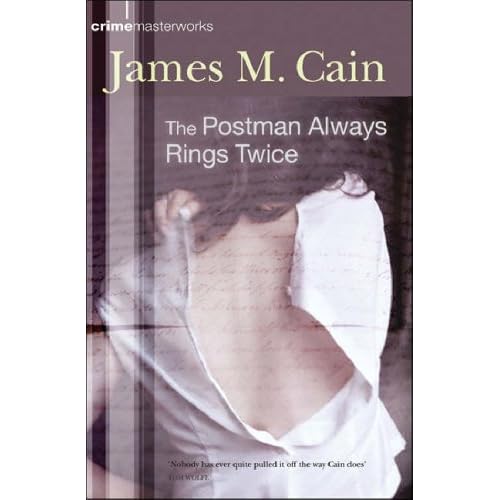
The Postman Always Rings Twice


Some books are just straight disturbing – this is one of them.

I initially thought it was only a tacky thrill getter – bit of sex, bit of violence and a ‘tough talking dude’ – but once I broke through that (and it did take some breaking through) I realized this is quite a well written book.

It is about violence – it is about alienation – it is about deprivation and emotional screw-up: It is about justice and the perverseness of morality.

That is a pretty strong cocktail, and the language, of necessity, is harsh, unforgiving and downright brutal at points.

So too the plot – with an economy to be admired, there is an attempted murder, a successful murder and an accident resulting in another kind of murder … all in the space of around 120 pages.

Women get slapped around – and like it: Men get beaten-up - and don’t. It is the ‘film-noir’ world beloved of the gangster genre. But this is not a gangster book.

The chief character is a drifter – he bums around America - scratching a living here, stealing there, spending short periods in jail before moving on.

He drifts into a situation where his animal driven lusts and craftiness allow access to what I am tempted to say is a perfect partner for him. There is the problem of her husband – and their attempt to remove him forms the spine of the story.

But, ‘As flies to wanton boys … ‘

The God’s agents are the forces of law and order – who are playing a game with lesser mortals. Any sense of justice or basic human decency is soon swept away once we encounter the petty motives fuelling both defence and prosecution.

I have to admit, I am reminded of Tess, of Lear and Heathcliffe … pretty strong company for a pot-boiler to evoke.


Technorati Tags: , ,

Saturday, 22 March 2008

'The Horror. the Horror'


Perhaps it’s the encroaching senility one starts to suspect as the memory finds it hard to drag up once familiar words; perhaps it’s the memento-mori of a deforming, never to be straightened, finger on an increasingly inefficient hand: Maybe it is just excessive experience and a corrupted world.

Whatever it is, my recent re-reading of Conrad’s ‘The Secret Agent’ has left me a little stunned.

Leopards might not change their spots – but works of literature can certainly change their meaning.

Once this was a stylish novel of superior language use, playing with the genre of spies and flooring the ‘le Carrés’ of the future before they even put pen to paper.

Well defined major characters and good descriptions – Dickensian almost but nodding to the modern.

This time it was a vicious (as only humour can be vicious) satire on certainties and politics.

In a world of ocean sized deceit, where atrocities and terrorism originate in ones friends and where one does not really know ‘the enemy’, small lives are wrecked leaving little flotsam to wash ashore.

Winnie, whose story this is, is as tragic a figure as you will find in any ‘Bodice Ripper’ – she marries, for the sake of her family, the safe middle class man who lodged with her mother; her mother leaves in order to safeguard the prospects of an idiot son; the son, brother to Winnie, is hardly noticed by Verloc, double agent for a seedy government, until he is pressured to breaking point by an enthusiastic know-nothing (young, First Secretary, Mr Vladimir).

No one is to blame – next to nothing happens, but a devastating hole is cut out in the reader’s faith in the essential goodness of the universe.

The terror comes with the realisation this is our world – this is the manipulation of modern governments and those agencies set up to protect us – Nothing has changed: If anything, it is more like this than it was at the time of writing.

Saturday, 8 September 2007

Bleak House (2)


As if on cue: The weather, after a month of people killing heat-wave, turns to rain - persistent and misery inducing.

In Bleak House, the weather is as bad.

We are still following events through the eyes of Esther, who seems to be developing into ‘our heroin’. She wakes and is induced to go for a walk thought the foggy, early morning streets around the Chancery – with the inevitable accompaniment of the slightly-lacking people she seems destined to pick up on her way through life – Miss Jellyby to the forefront.

After the equally inevitable reminders of Miss Jellyby’s mother’s negligence, and heavy indications that ‘the wards in the case’ are getting on rather more strongly than distant cousins need to fulfil family duty, up pops the mad woman.

We are not destined to learn her name – she is the ‘little old woman’ she is ‘our hostess’, she is ‘the lodger’; she is the great anonymous: Details, if ever known, now lost and only to be revealed on ‘Judgement Day’.

Another unknown is presented to us in Nemo – advertising on the door of the shop above which the old lady lives where there is a difficulty gaining entrance.

What isn’t kept long from us is the landlord and shop’s owner, Mr Krook. (Crook for bent and deformed? Or crook for criminal?)

We soon lean what is either ignored in t.v. adaptations or passed quickly over – he is the second Chancellor! And proud of it.

Surround by endless papers in dusty, fading piles; unknowing, uncomprehending what he has or what its value; holding on, not selling – accumulating the detritus of other people’s lives.

Suddenly, that most powerful of Dickensian tools, the physical description, so attractive to designers yet so inaccessible visually, clicks in – the shop is a metaphor – chaos and confusion - physical, mental, moral, spiritual; with a bent old cipher sitting enthroned in the centre.

Guard to this treasure house is the most vicious cat in literature.

Up in the lodger’s rooms we discover a barren place with captured birds – again, not the pretty yellow canaries tweeting careless of their captivity, so beloved of the filmmakers – dusty, nearly dead things the RSPCA would instantly prosecute you for – and gas out of their misery.

The camera lens can only capture what it sees, it fails to grasp the multi-layering that comes with the multi-perspective a good novelist can give.

Esther’s ‘Morning Adventure’ in this New (if not brave) World bruises through a thuggery of words that are only more numbing because of the naiveté of the narrator.

The day progresses and we move into sunlight and refreshing air as the three young people continue their journey to start residence at Bleak House.

It is a tiring journey but the natural optimism of Esther shines through – and we eventually enter the most un-bleak of houses. Mr Jarndyce awaits – an old man terrified of thanks and totally incapable of accepting other people’s faults.

He is a stark contrast to Krook but Dickens makes an intriguing parallel in the settings where we find these two: Irregularity. Bleak House might be, in Esther’s words, “Delightfully irregular,” but there is no doubt in the reader – all is not well.

Like Krook, Mr Jarndyce is in a physical and, by implication, moral and psychological maze. Esther has not only been thrust into it, but is soon given the keys and made housekeeper.

Another odd aspect of Mr Jarndyce is his ability to bring the weather indoors. The closest expression of disapproval and unpleasantness he is capable of is to comment on the direction of the wind: “From the east,” gives Mr Jarndyce, “an uncomfortable sensation.” One suspects the sensation, originating in the foibles of humanity he refuses to recognise, is the source of his meteorological observations. By the end of this chapter, in fact, a full-blown gale is being summoned.

Resident at Bleak House is Mr Harold Skimpole, the personification of innocence and childlike understanding according to both himself and Mr Jarndyce. Others might, after hearing the tale he tells of his employment in Germany, suspect a lazy good-for-nothing exploiting consciously the weakness of others. Esther and Richard soon fall victim to him, being forced to hand over money to prevent Skimpole being hauled off to gaol – and it is Mr Jarndyce’s discovery of this which prompts his tempestuous predictions.

As expected though, Esther signs off her shift as narrator with a, and “. . . hopefully to bed.”

But Dickens has not done with us – bookend like, the omniscient persona of ‘our author’ returns to give a little coda on ‘The Ghost’s Walk’.

This is a deceptive title. Superficially it is the thrill seeking description so beloved of the tour guide – for, what is the content of this chapter but a guided tour of Chesney Wold, Lady and Baronet Dedlock’s sodden country house in Lincolnshire?

Mr Guppy, from London, suggesting a higher legal status than his lowly clerkdom, gains access with a friend, and is shown around the house by the housekeeper’s protégé, Rosa. They are accompanied by the housekeeper’s grandson who is visiting and who provokes in Rosa a beauty intensifying self-consciousness that doesn’t escape the notice of Mrs Rouncewell, grandmother and solid feature of the house.

Guppy notices a portrait the likeness in which he feels to be familiar, but he cannot, for the moment place. It is of the present Lady Dedlock, but Mr Guppy has never seen her.

The tour concludes, as always, with a view over ‘The Ghost’s Walk’ – a terrace with the sort of less-than-respectable history guaranteed to thrill the respectable, rising middle-class viewer of country houses.

Once Guppy has been shown out by a young gardener, Mrs Rouncewell, widowed some time ago and with two sons, one gone bad, the other risen and grandson producing, reveals more of the true nature of the walk.

Some long dead Dedlock, cursing the family, walks the Walk whenever disaster and disgrace is coming to the proud family. The sound of her footsteps, despite loud-ticking musical clocks, will be heard, through the beat and the notes, as Rosa now hears them, and as Lady Dedlock claims to have heard.

Is he ghost’s walk the terrace? No, it is the sound produced by that wonderfully Dickensian touch-of-the-gothic, predicting the final humbling of an over-proud house. It is the unendurable, to Lady Dedlock, dripping of the rain.

(A little late publishing, but read on time!)

Wednesday, 24 January 2007

Sisyphus, Androids and Mercer

There is certainly something in the connection between the legend of Sisyphus and the daily, never-ending battle against rogue Androids in 'Do Androids Dream of Electric Sheep'.

Sisyphus is condemned to push a heavy rock up a hill and will only be released once he reaches the top - but, as the top approaches, the rock escapes and runs down to the bottom of the hill: Sisyphus has to start all over again.

This is a metaphor for never ending toil - the sort of toil needed to keep a vegetable garden weeded (before the 'devil-opment' [sorry, I'm organic] of chemical weed-killers), or perhaps that of the worker on a production line doing a repetitive job at the command of a conveyor belt.

As this, there is nothing special in P.K. Dick's use of the myth for Rick Deckard's set toil - if he had it in mind at all. Camus applied the myth as a metaphor to modern life – but modern life didn’t consciously apply the myth to itself – Camus simply made the connection. Dick could simply have had modern life in mind when developing the story rather than the myth of Sisyphus.

One interesting question people don't often ask about the myth is, "Why was Sisyphus condemned to this punishment?"

Sisyphus has attempted to deceive - deception is at the root of the labour.

Is their deception in, 'Do Androids...'?

Rather a lot.

Rick opens the novel being woken by a shock from his organ [sorry, it's 'second childishness' creeping in: And whilst I’m at it, what are nom-de-plumbs for if not to replace unfortunate surnames like ‘Dick’?].

His mood is artificially set; it is not honest. His wife, who has an element of fight against this sort of mind control, refuses to participate in the deception of induced moods.

The androids themselves are a deception – multi-layered: They are not human but look it; they do the essential work human’s think they are too superior for in space (but still perform on earth – by using ‘chickenheads’, classified as subhuman); the Rosen Association develops increasing sophisticated androids which are designed to ‘cheat’ the tests of bounty hunters like Rick; and the androids don’t necessarily know they are androids as they are given false memories.

And what are we to make of electric sheep?

The pastoral myth of carefree shepherds is set in contrast to Sisyphrian labour: However, the sheep are as likely to be an electric deception as real.

The result of these deceptions is the labour which dehumanises Rick and which he longs to escape. (Interestingly enough, the Dream Factory film version lets him do so at the end – not that I have seen it.)

And a final twisting deception: Rick’s job is to protect humanity from the ‘de-human’, from the android - that labour is itself dehumanising.

There are certainly strong parallels between the Myth and the novel, but I still don’t think we can yet say Dick consciously used the myth.

So let’s turn to Mercerism: Here is the strongest evidence that P.K. Dick refers to Sisyphus knowingly.

What happens when humans grasp the handles of the empathy box?

It is in a landscape of barrenness, reminiscent of Jesus in the wilderness, that humans merge, to toil up a merciless hill, “Impossible to make out the end. Too far. But it would come.” (Chapter 2, pg. 20)

This repeated climbing of a hill is surely direct reference to the Sisyphus myth – with a difference: The top is attainable.

We first encounter the empathy box in the hands of the ‘chickenhead’, John Isidore – and he has been to the top – where the ‘other part of it’ begins.

Whatever this other part is, however painful, people still join together through the empathy box in order to struggle to attain it.

We have to be careful though with any information that comes via Isidore – he is, after all, a ‘special’. P.K. gives some intriguing information about the finding and early existence of the character – he was picked up from a boat off the coast (possibly Mexico) is adopted by a family called Mercer (!) and seemed to have the ability to bring dead animals back to life – which made him, “…. more special than any of the other specials.” (Chap 2, pg. 21)

I am not so sure that ordinary humans manage to get to the top – their existence is more bound to the labour of Sisyphus than this special’s is.