Tuesday, 13 May 2008

P. G. Tips


P. G. Wodehouse

There are certain books and certain authors one is coy about naming in the realms of favourites – Mr Wodehouse is one.

Ever since teenageness I’ve been drawn to the chaos of the phantom upper-class world he scratched out – less enamoured, I have to say, of the American excursions. What attracts is difficult to say – maybe the downright silliness of them.

Wodehouse was a writer of copious amounts – included lyrics for musical comedies (some 30 all told – around 250 songs). And therein lies the first clue to enjoying a Wodehouse – a good one will be like spending a couple of hours in the theatre – a ‘musical comedy’ approach is necessary, a ‘between-the-wars’, musical comedy approach in fact.

Love and ridiculous complications, mad uncles and tart aunts, rich old fogies and poverty stricken young things … warm balmy, never to be repeated summer days, and policemen (who appear solely for the purpose of knocking their helmets off in order to be captured and dragged along to the local magistrate – who will turn out to be the offenders, as-yet-un-met father of newly affianced fiancĂ©).

Uncle Fred in the Springtime has most of these elements or a variation thereof – and the Blanding’s Pig.

The story is not really essential – in this case it revolves around one Uncle, Fred, trying to get another Uncle, the Loony Duke of Dunstable, to behave in a reasonable manner and cough up lots of money to support his poetry writing nephew in the enterprise of an onion soup stall in Picadilly, which will facilitate the said poet’s marriage – to the dance teaching daughter of a private detective. There is also the sub plot of preventing the removal of Lord Emsworth’s pig by the poker wielding Duke, who is convinced Emsworth wishes to enter the pig in the Derby, and the supplying of even more money to Fred’s nephew who is in danger of several broken limbs and a long stay in a hospital bed on account of debts unpaid.

Confused? – you are allowed to be. And yet there is a clarity in the confusion – you never get confused enough to lose track, (either that, or you are laughing too much to care) and something new pops up so quickly you do not notice any confusion in yourself whilst noticing it in the story.

And that’s my next tip – take a chair into the garden, a bowl of strawberries (peppered) and an ice bucket with a bottle of champagne and one flute. Position yourself – and read. Don’t ‘do’ a Wodehouse in too many sessions – it’s a two act-er rather than five. Just let the whole silly story flow over you and worryeth not about following every detail. Being tipsy helps.

Most Wodehouses have a central character around whom things fly (revolve is far too sedate a word). Here it is Uncle Fred – not surprising really, given the title.

He’s a lovely old buffer – Shakespeare quoting, so an instant success with me – although not so with his nephew and niece, nor his fortunately absent wife. He has an aging Puck-like quality of solving problems in a way which causes maximum difficulties for all around, including ‘Uncle Fred’. Rarely does he doubt himself – everything will resolve satisfactorily, by magic it seems.

Fred is very ‘hands-on’ – preferably his nephews or other gullible young tyke, or co-operative young tyke-ess (who knows a good plan when she sees it). Nice young things fall for him instantly – sour prunes not so (one is left with the suspicion his absent wife is more the former than latter – but plays a good part in appearing shrivelled).

Fred’s biggest challenge is his contemporaries – who seem to have grown crabbed with age. Principle is Emsworth’s wife – who is the sort of woman who’d take a hairbrush to the backside of some poor nephew at the drop of a cricket ball (through the greenhouse window). Her biggest weapon is knowledge – of Fred’s wife – and access to a jungle telegraph more effective than e-mail. A minor danger, swiftly dealt with, is his neice – who is apprentice sour prune.

In a similar class to the niece, is the secretary – male. I suspect Wodehouse had problems with one of these early in life and consequently took a hatchet to the species whenever the opportunity arouse. Dishonest, devious, cowardly, ganging up with the united forces of vinegar-women and Loony-Dukedom. Fortunately he gets truly egged.

And there is the passion-for-taking-money-off-other-people-with-a-card-game, Private Detective – who just happens to be the father of a wanna-be poet’s bride.

How could a story fail with such a classic bunch of caricatures? Quite easily – but not on Wodehouse’s typewriter. Lesser writers would find it very difficult to assemble an entertaining castle on such foundations.

Wodehouse’s cement is a wit with language – and spare, effective, cutting dialogue (no doubt sharpened in the fifteen plays he joint wrote). It is not surprising adaptations of his novels and stories make such good television.

Comedy is part of the double faced mask of Drama – the Ancient Greeks gave it equal status.

Somewhere in the Judeo-Christian European Middle Ages it seems to have been demoted to trivia and superfluity: I’m a pagan in this.

Give me a Wodehouse … and I want it now!


Technorati Tags: , ,

Saturday, 10 May 2008

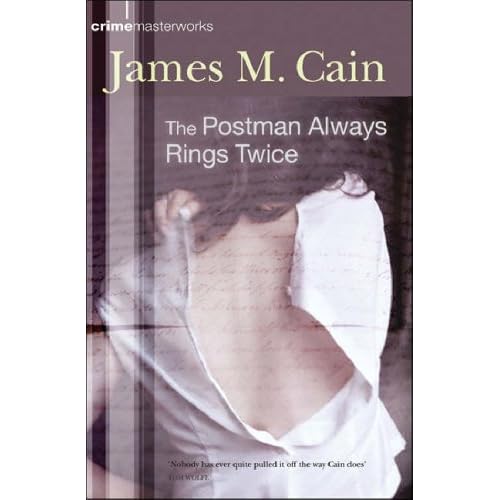
The Postman Always Rings Twice


Some books are just straight disturbing – this is one of them.

I initially thought it was only a tacky thrill getter – bit of sex, bit of violence and a ‘tough talking dude’ – but once I broke through that (and it did take some breaking through) I realized this is quite a well written book.

It is about violence – it is about alienation – it is about deprivation and emotional screw-up: It is about justice and the perverseness of morality.

That is a pretty strong cocktail, and the language, of necessity, is harsh, unforgiving and downright brutal at points.

So too the plot – with an economy to be admired, there is an attempted murder, a successful murder and an accident resulting in another kind of murder … all in the space of around 120 pages.

Women get slapped around – and like it: Men get beaten-up - and don’t. It is the ‘film-noir’ world beloved of the gangster genre. But this is not a gangster book.

The chief character is a drifter – he bums around America - scratching a living here, stealing there, spending short periods in jail before moving on.

He drifts into a situation where his animal driven lusts and craftiness allow access to what I am tempted to say is a perfect partner for him. There is the problem of her husband – and their attempt to remove him forms the spine of the story.

But, ‘As flies to wanton boys … ‘

The God’s agents are the forces of law and order – who are playing a game with lesser mortals. Any sense of justice or basic human decency is soon swept away once we encounter the petty motives fuelling both defence and prosecution.

I have to admit, I am reminded of Tess, of Lear and Heathcliffe … pretty strong company for a pot-boiler to evoke.


Technorati Tags: , ,

Friday, 2 May 2008

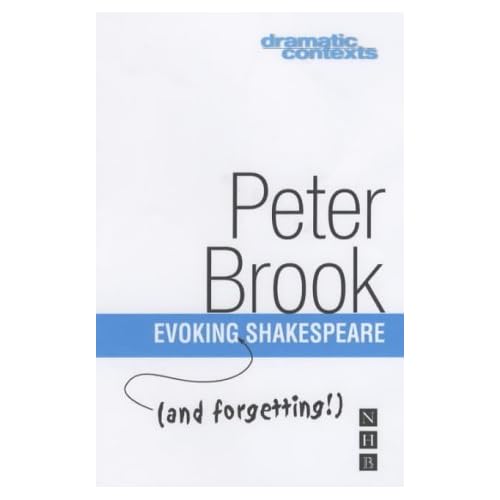
Shakespeare Experience: Forget Shakespeare!


The second part of my 'review' of Peter Brook on Shakespeare:

Shakespeare Experience: Forget Shakespeare!

I posted it over there as it seems to me to be more to do with Shakespeare and experiencing him in performance than reading him.

I must admit - I tend to read Shakespeare for performance anyway, so a touch of bloody-mindedness in the decision.

It is a book I was reluctant to buy initially as it cost so much for so few pages - Mind changed: It was worth every penny.


Technorati Tags: , ,

Sunday, 27 April 2008

Saturday, 26 April 2008

Friday, 11 April 2008

Nuclear Shakespeare


Each line in Shakespeare is an atom. The energy that can be released is infinite – if we can split it open.

(pg 25, Evoking Shakespeare: Peter Brook)

This is quite a short work – the transcript of a talk given in Berlin in May, 1996. As such it runs only to 32 pages, including the question and answer session at the end of the talk.

I must admit, when it arrived, I got into a bit of a huff: Six Pounds Sterling (and postage on top of that) for such a short work was a little expensive.

(The publisher has obviously realized this – and added on to the end nine more pages of text from what I assume is either another talk or possibly a magazine article on ‘Forgetting Shakespeare’. I’ll post separately on that as, although there is a Shakespeare connection, I think there is a fundamental difference between the two and both benefit from the separation.)

However, it didn’t take me long to realize, rather than merely spending a pot of tarnishable silver, I had bought pure gold.

In essence, Peter Brook gives a short answer to a deep question –

‘Why isn’t Shakespeare out of date?’

Key to appreciating the richness and longevity of Shakespeare's texts is an understanding of the innate abilities behind their creation. A phenomenal memory can be counted as ‘top of the list’ of these abilities.

It was a memory for language, for nuances, for ‘feeling’.

I am reminded of Mozart on this point – who was able to listen to the setting of the Miserere by Allegri in one sitting and write it out: Whether such an ability is ‘savant’ or trained is irrelevant – it is the possession of such an aptitude that has enabled both of these ‘geniuses’ to go on and use what they remember.

Shakespeare was able to observe, to assimilate and to remember (in what Brook calls the ‘Shakespeare Brain’) the live, thriving, international wonder that was Elizabethan and Jacobean London.

But this, on its own, is not enough – we have to add a second inheritance – the capabilities of a ‘poet’.

Brook describes this as the facility to see connections where we do not normally see them; to choose words which don’t just ‘define’ but which resonate. It is an ability to be human – with a difference.

Imagery is used by a poet in such a way as to go beyond ‘concept’; there is ‘music’ in the arrangement of words – not the crass music of the drama student beating out the ten beats of the pentameter and going no further, but the subtle music of the spheres Shakespeare and his ilk are able to suggest by the apparently simplest arrangement of words.

Brook assumes Shakespeare wrote fast and started with a story. But Shakespeare was not writing journalism, and he was not writing for the print media – he had a stage, a specific space to write for – and to use.

Like the Globe, the Swan, the Rose, there are levels in the texts which originate in the physical arrangement of the acting area. This was a totally new space – nothing had ever existed quite like it before, and Shakespeare and his contemporaries had to invent a new ‘theatrical’ language to exploit the resources. Theatres were places of intensity – places of concentration, places which showed the truth that lay behind the ‘sense’.

Above all other things though, the theatre was based on ‘platform’ – which gave a fluidity and ‘lack of security’ the theatre people had to cope with.

Orson Welles was faced with a similar challenge and reacted with similar excitement and creativity when he made Citizen Kane.

Brook makes the point that both Welles and Shakespeare created a language that was ‘easy to understand’ – you needed no training to follow the works of either story-teller: It came naturally.

Perverse, then, the difficulties thrown up around modern productions of Shakespeare. Now the language, after the academics have had their hands on it, seems artificial and unusual – and this is not a product of the aging of the words, it is deliberate ‘strange-making’ in search of genius – Shakespeare is the unique genius therefore he must do difficult amazing things.

If the works have survived despite this (and not because) they have done so because of they reveal. That revelation comes in performances of the works which communicate with ordinary people. What must a production do in order to communicate, what must the language of Shakespeare appear to the audience?

Brook makes the point very clearly:

Shakespeare must seem natural!

This is a great lecture – there are questions and answers tagged on which explore some of the ideas Brook touched on (I especially like the extension on the nature being nurtured) and some, like the problem of working with Shakespeare in French, not.

Sunday, 23 March 2008

An honest Wit(ness)


Above all other things, Germaine Greer (bbke) is Witty.

I don’t think I’ve ever read a biography before where the knowledgeable smile of the author has been so evident – and, if there is any truth in the idea of all biography being covert auto-biography, forget the Mona Lisa, Anne Hathaway has now had ‘the face job’.

Does anyone else understand the Shakespearean (strictly Elizabethan) idea of worldly illusion – and apply it – as Ms Greer (bbke) does? I think not.

Totus Mundus Agit Histrionem.

Our intrepid author, perversely, writes not of The Author, but of His shackle, ‘her indoors’.

This, in itself, should send a shiver of dread through the bones of the bardolating – what is the woman up to? Everyone knows what a ‘Shrew’ the witch of Stratford was – how she first tricked Him into marrying her, then drove Him from home; how He had to seek comfort in the stews of London and how He got His revenge by drinking Himself to death and leaving her nothing in His will!

Dare this exiled, antipodean troublemaker challenge that?

Well, yes, she dare. And with good reasons – in multitude.

Almost without exception, those biographers of Shakespeare who deal with his wife and family seem to groundlessly condemn her. What evidence there is, is almost unintelligible in modern times and needs filtering through the eyes of the Elizabethan/Jacobean – and more specifically through the eyes of an Elizabethan/Jacobean in Stratford.

This is precisely what Ms Greer(bbke) does – gives the perspective of Stratford and the times. The factual details not only of Shakespeare’s wife and family are given – but also the context of what else is happening in Stratford when they live there.

Three times in Ann Shakespeare (nee Hathaway)’s lifetime significant parts of Stratford burnt down: Mini-fire-of-London events that had dire consequences for the town’s economy and for Shakespeare’s family.

The idyll of a quiet, prosperous, country backwater does not fit the cataclysm of such events (or of the near riots and murders also documented in the book) – events that make the purchase price of buildings like New Place quite reasonable – and well within the reach of a not too prosperous playwright’s wife.

And strong evidence is given of the independent nature of many women in the town – women who leant money out at 10% interest, made a reasonable income by malting and other industries (frequently credited incorrectly to their husbands) – and women who supervised the restoration of houses when their husbands were absent.

Greer (bbke) makes few claims to certainty – indeed, her most certain claim is of the uncertainty of the material (a claim not all biographers of Shakespeare have taken to heart). Frequently you are given more than one possibility as to events – possibly this, possibly that - only to be told, as a parting shot – and possibly neither.

Shakespeare’s death is one such case.

If the William had contracted venereal disease then …. (and it would make sense of the doggerel verse in the church about not moving the bones).

However, he might also have had cancer, in which case ….. (and the known facts fit this too).

But we do not have enough evidence for either to be certain – or for other possible explanations.

This is how the biography is constructed throughout – like Shakespeare, Ms Greer (bbke) gives us more than one possible answer to the questions she raises – and leaves us to make up our minds.

Sometimes she goes as far as to say, ‘If, as I think, Ann …’ But that is it.

What she does give short shrift to (and rightly so) is the idiocy of certain (male) biographers who presume too much on little or no evidence. Shakespeare’s presence at family funerals is one such presumption – based more on wish fulfilment than any evidence.

Another revolutionary challenge to conventional wisdom Ms Greer (bbke) makes (absurd claim she labels it – tongue firmly in cheek) is that the only reason we even have so much Shakespeare text is Ann’s devotion to her husband – it could well have been her doing, The Folio – she might have paid for its printing (or rather underwrote the inevitable loss), just before she died. In theatrical terms this makes her an Angel – and a very different person from the harridan portrayed by the men.

Which brings me nicely back to the link between the biographer and her subject …

If Shakespeare has a modern Angel – it is Ms Greer: Make no mistake, Shakespeare’s wife is the subject of the biography – but de-bagging some of the scholastic absurdities surround Shakespeare is firmly the aim.

It also does a nice job of restoring the unity and balance of marriage, one of Shakespeare’s most enduring themes.